
Radon is the second-leading cause of lung cancer in the United States. The EPA estimates it kills about 21,000 people per year, which is why the question comes up on nearly every home inspection. You can sell a house with elevated radon readings. There is no federal law that requires testing before you list. But if a buyer orders a test, their lender may condition the loan on mitigation, and in several states you are already required to disclose any results you have in hand. The gap between "can sell" and "easy to sell" is where the numbers get interesting.
The 4.0 pCi/L threshold and what it does to your buyer pool
The EPA's action level is 4.0 picocuries per liter (pCi/L), set out in the agency's Citizen's Guide to Radon (EPA 402-K-12-002, 2016). The average indoor radon level across US homes is about 1.3 pCi/L; outdoor air runs around 0.4 pCi/L. At or above 4.0, EPA recommends fixing the home before continued occupancy.
Below 4.0, a lender typically does not require action. Above it, the buyer does one of three things: walks, negotiates a credit or price cut, or waits for the seller to mitigate. In states where lender guidelines or state law tie into the EPA threshold, the loan cannot close above 4.0 without completed mitigation and a passing post-mitigation test on file.
The reading that kills the most deals is not a borderline 5.0. It is a 15.0 reading that surfaces mid-inspection on a buyer who has never seen radon numbers before and does not know how to assess the risk. That buyer often walks, even though the fix for a 15.0 pCi/L reading costs exactly the same as the fix for a 5.0 reading.
There is no federal radon disclosure law for existing homes
Lead paint has 42 U.S.C. §4852d, a federal statute requiring sellers of pre-1978 homes to disclose known hazards and give buyers a 10-day inspection window. Radon has no equivalent. There is no federal law requiring residential sellers to test, disclose results, or mitigate.
What you must disclose depends on state law, whether you already have test results in hand, and your agent association's standard disclosure form. Several high-radon states have specific statutes:
- Minnesota: Minn. Stat. §144.496 (the Radon Awareness and Mitigation Act, enacted 2009) requires sellers to provide buyers with a copy of any radon test results they hold. Real estate agents must give buyers a written radon notice at or before signing. This is a defined legal duty, not a discretionary best practice.
- Iowa: Iowa Code §558A.4 includes radon in the mandatory seller's disclosure statement. If you have elevated results, the form has a line for them and you fill it in.
- Montana: MCA §37-51-306 covers environmental hazards in the property condition disclosure statement. Elevated radon falls under that heading.
- Wyoming: Wyo. Stat. §33-28-301 et seq. does not single out radon by name, but requires disclosure of known material defects. An elevated test result in your possession is a known material defect.
The practical rule in every state: if you have results, you disclose them. If you have never tested, you disclose that too. "Never tested" is not a claim of safety. What you cannot do is withhold results you already hold. Doing so can expose you to fraud liability after closing regardless of what the state statute specifically lists.
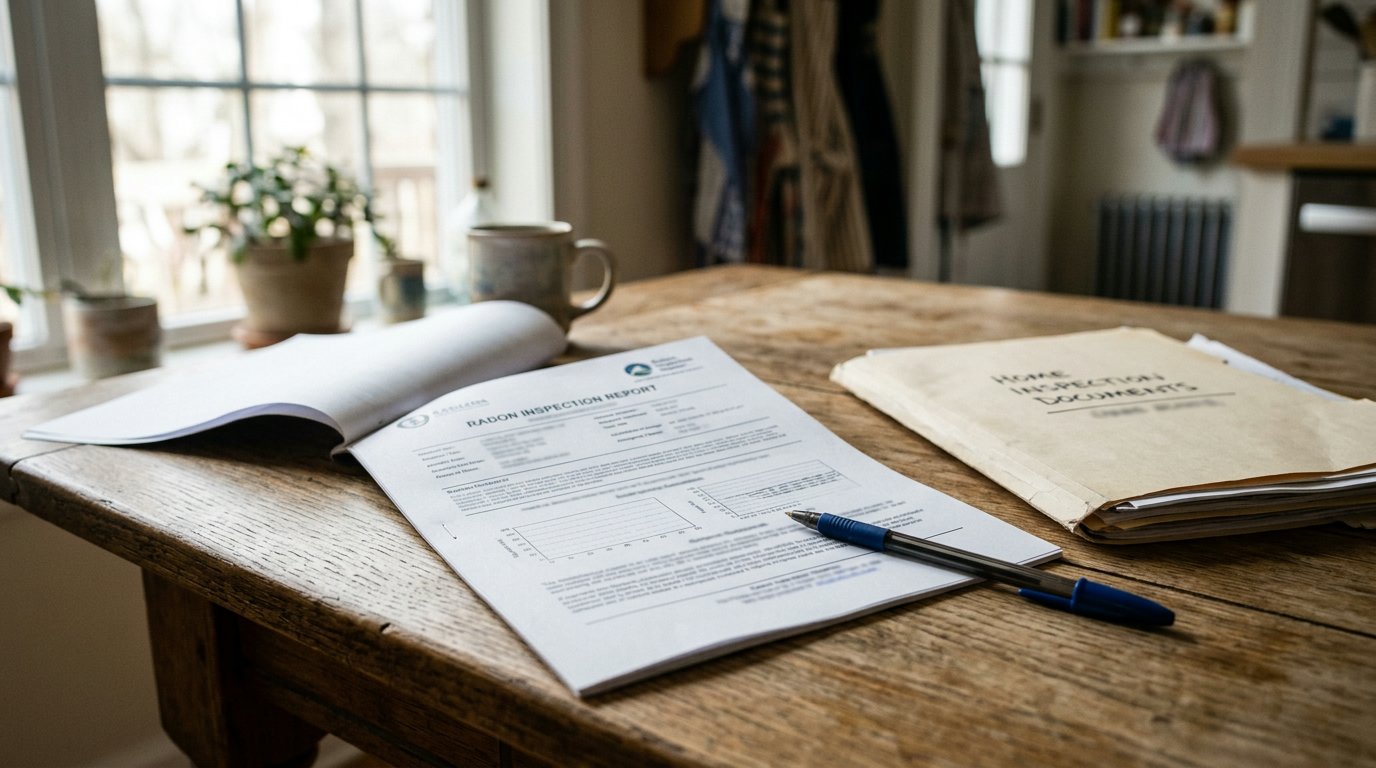
What FHA and VA appraisers do with a radon reading
FHA appraisers work under HUD Handbook 4000.1, Section II.A.8.a.i, which covers environmental and safety hazards. If a state requires radon testing before closing (a handful of state-specific FHA guidelines add this requirement), the test must be in the underwriting file. If a result above 4.0 pCi/L is in the file, FHA conditions the loan on completed mitigation and a passing post-mitigation test before funds are released.
VA follows VA Lender's Handbook Pamphlet 26-7, Chapter 12, minimum property requirements. For new construction in EPA Zone 1 counties, where the EPA's nationwide map predicts average indoor levels above 4.0 pCi/L, VA has required passive radon-resistant construction features since a 2009 update to its minimum property standards. Zone 1 covers most of Iowa, the Minnesota Iron Range and Twin Cities metro, much of the Wyoming Wind River and Laramie ranges, and large parts of Montana's Clark Fork valley. For existing homes, VA tracks state disclosure law but applies the same loan-condition mechanism as FHA when elevated results are in the file.
The loan condition is the mechanism that converts a test number into a deal delay or a deal failure. A cash buyer has no lender, no appraisal, and no loan condition. That is why a direct sale exists as a practical exit when the mitigation timeline does not fit the closing window.
How mitigation works, what it costs, and whether the system hurts your sale price
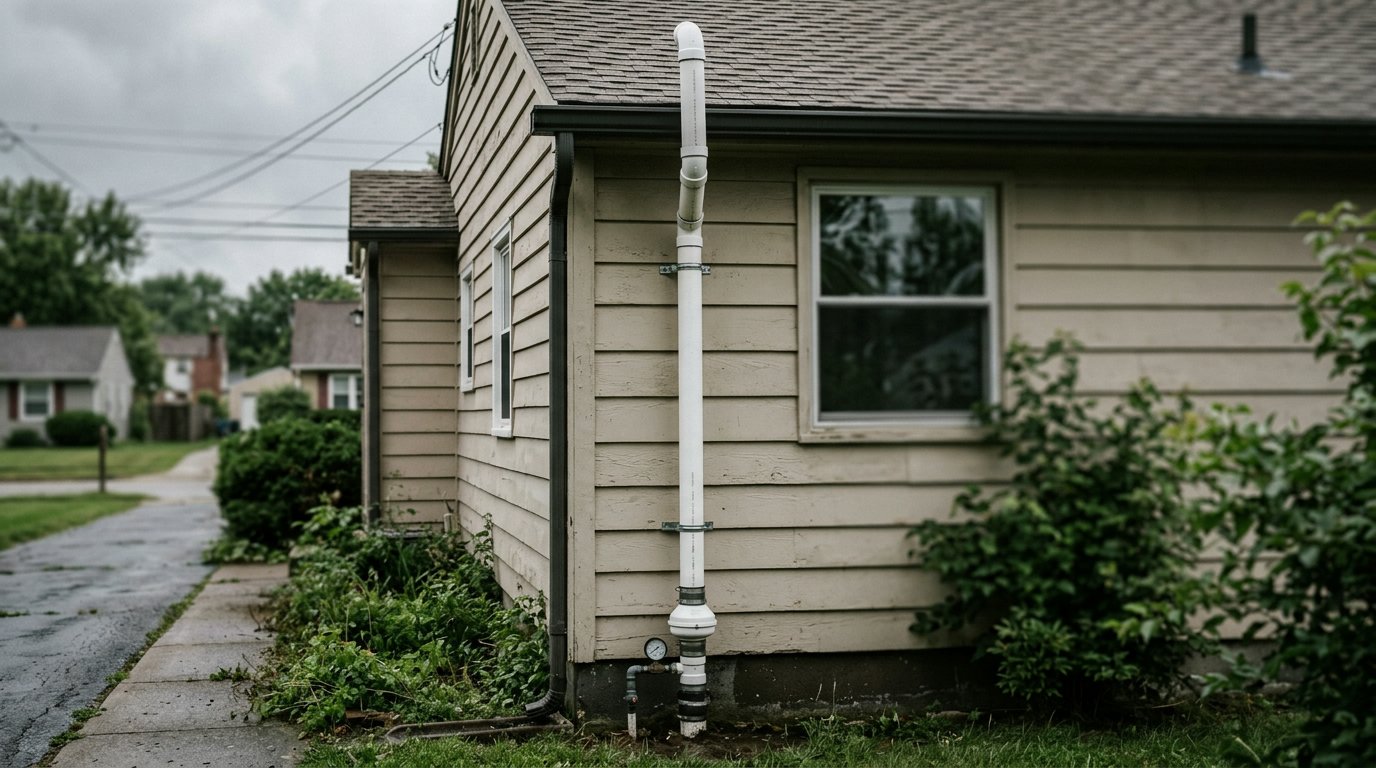
The standard fix is sub-slab depressurization (SSD). A contractor drills one or more holes through the basement slab, routes a PVC pipe up through or around the house, and attaches a continuously running fan that draws soil gases, including radon, out from under the foundation and vents them above the roofline. The gas exits outside rather than seeping through cracks in the slab into the living space.
Installation cost: $800 to $2,500 for a typical single-family home, with most jobs in the $1,200 to $1,500 range. Fan electricity adds roughly $10 to $25 per year. A properly installed system almost always brings post-mitigation readings below 2.0 pCi/L, well below the action level.
The question buyers ask: does a system on the property hurt the sale price? The answer in most markets is no. A functioning system with a passing post-mitigation test on file says the problem was found, professionally fixed, and documented. A home with no test history gives a risk-averse buyer nothing to evaluate. In EPA Zone 1 markets like the Twin Cities metro or Billings, buyers who understand radon often find a mitigated house easier to close on than one with an unknown status.
What does hurt the sale is an elevated reading found mid-inspection on a never-tested house, with no mitigation in place and a 30-day closing window. The buyer must either renegotiate, wait for mitigation to complete and retest (adds 2 to 4 weeks minimum), or walk.
Worked example: $285,000 Minneapolis house, 12 pCi/L
A 1970s rambler in the Minneapolis metro, never previously tested, comes in at 12 pCi/L on the buyer's inspection. EPA Zone 1 county. The deal pauses pending resolution.
| Path A: Mitigate, relist | Path B: Cash sale as-is | |
|---|---|---|
| ARV / offer price | $285,000 | $248,000 |
| Mitigation + retest | $1,550 | None |
| Agent commissions (6%) | $17,100 | None |
| Seller closing costs | $2,850 | None |
| Carrying cost, 45-day relist | $2,250 | None |
| Net to seller | $261,250 | $248,000 |
On paper, Path A returns $13,250 more. That holds if the relisted house sells at full ARV, no further inspection surprises appear, and the second buyer is not spooked by the radon disclosure history on the property. It often does work out this way, and the gap is real.
But the risk is also real. The original buyer already walked once. Any future buyer in Minnesota will see the disclosure, know the property was pulled from the market, and may use the history as negotiating leverage. If the relist takes 90 days instead of 45, the carrying cost roughly doubles and the gap narrows to about $7,000. If the second buyer also negotiates a credit, the gap narrows further. The cash path at $248,000, closed in 7 to 14 days, removes all of that uncertainty at a known cost.
For more on buying and selling houses in Minnesota, see our Minnesota cash home buyer page.
Who should not take a cash sale on a radon issue
If your reading is just above 4.0, the house is in otherwise good shape, and you have 60 to 90 days, the traditional path almost certainly nets more. Mitigate (typically $1,200 to $1,500), retest, disclose the passing result, and list at full price. The mitigation cost is small relative to the discount you accept in a cash sale.
A cash sale makes more sense when: the reading is well above the action level and you are not sure what else an inspection will surface; the closing window does not allow time for mitigation and a 48-hour retest; or the house is already being sold at a discount for a separate reason and adding a radon complication to a conventional lender's requirements is the issue that pushes a buyer out.
Radon mitigation is cheap relative to most repair problems that kill a sale. If that is the only issue, fix it before listing. If it is one issue among several, see whether the total picture changes the math. For context on how repair costs interact with the cash-sale discount across a range of problems, read our guide on selling a house that needs major repairs.
A cash offer from Trusted Homebuyers USA is typically below what a fully marketed retail listing nets. A traditional sale usually comes out ahead if the house is in good condition and you have time. If the combination of radon, other deferred maintenance, and a tight timeline makes the conventional path uncertain, request a cash offer and compare the numbers directly. You can also call us at 208-540-8257 with questions about where your situation falls.
Common Questions
Can you sell a house with radon above the EPA action level?
Yes. No federal law prohibits selling a home with elevated radon. The practical issue is that a buyer using FHA or VA financing may have the loan conditioned on mitigation if a test result above 4.0 pCi/L is in the underwriting file. A cash buyer has no lender and no loan condition, so the elevated reading does not pause the closing. You can also mitigate before listing and provide the passing post-mitigation test as part of the disclosure package, which often strengthens buyer confidence rather than undermining it.
Does radon disclosure hurt your home's sale price?
Disclosing an elevated test result can affect negotiation, but disclosing a passing post-mitigation test rarely hurts the price. In EPA Zone 1 states like Minnesota and Iowa, buyers are accustomed to radon disclosures. A house with a documented, functioning mitigation system and a sub-2.0 pCi/L retest is easier to finance than a house with no test history at all. The damage to price comes from an elevated reading discovered mid-inspection with no prior action, not from a disclosure that says the problem was found and professionally resolved.
What states require radon disclosure when selling a house?
No state currently requires a seller to test before listing. Several require disclosure of known test results. Minnesota's Minn. Stat. §144.496 is the most specific: sellers must give buyers a copy of any results they hold, and agents must provide a written radon notice. Iowa Code §558A.4 includes radon in the mandatory disclosure statement. Montana's MCA §37-51-306 covers environmental hazards. Wyoming requires disclosure of known material defects under Wyo. Stat. §33-28-301 et seq., which covers elevated test results in your possession. A simpler rule that applies in every state: if you have results, disclose them. Withholding known test results can create fraud liability after closing regardless of what the state statute lists by name.
Does a radon mitigation system decrease home value?
Generally no, and in high-radon markets it can add value. A functioning sub-slab depressurization system with a passing post-mitigation test on file signals that the risk was found and professionally addressed. Buyers in Minnesota, Iowa, Wyoming, and Montana increasingly treat a system as a positive signal rather than a warning flag. What decreases value is an untested house in a Zone 1 county, because a buyer who orders a test during inspection is taking on that uncertainty, and they will price it into their offer or use it as negotiating leverage. Mitigate before listing when the timeline allows. It is almost always cheaper than the discount a mid-inspection discovery produces.