
You can sell a house with an oil tank. What determines whether that sale goes quickly or stalls for months depends on one question: is the tank above ground with documentation, or buried and forgotten. A buried tank with no decommissioning records will block FHA, VA, and most conventional loans, because lenders will not fund a mortgage on a property with an unresolved underground petroleum source. A cash buyer takes the property as-is, but the offer reflects the cleanup liability the buyer inherits.
Above-Ground Tank vs. Buried Tank: The Situation at Closing Is Different
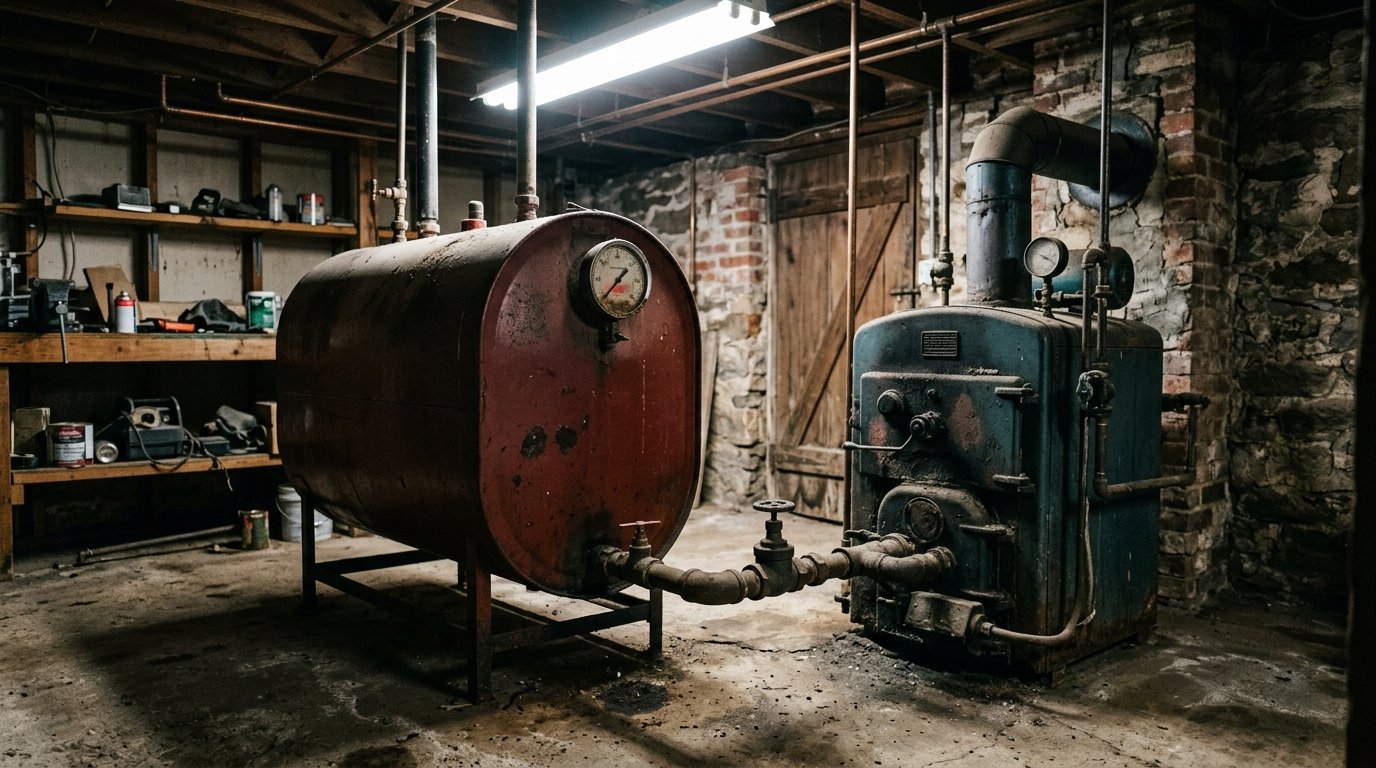
An above-ground tank inside a basement or utility room is visible and assessable. A buyer can see it, an inspector can evaluate it, and if the tank is active and in good condition, many conventional lenders will accept a seller credit for decommissioning or require pump-out before closing. Some buyers will not object to an active above-ground tank at all, particularly if the house still runs on oil heat.
A buried underground storage tank is a different situation. Most residential USTs were installed between the 1930s and the 1970s, when oil heat was standard across the Northeast and upper Midwest. When natural gas reached these neighborhoods, millions of homeowners switched heating systems and left the old steel tanks in the ground, sometimes still holding residual fuel. Steel corrodes. Corroded tanks leak. Leaked petroleum migrates through soil and can reach groundwater. The environmental liability that results stays on title and follows the property to each successive owner.
If your house was built before 1975, sits in the Northeast, Mid-Atlantic, or upper Midwest, and ever ran on oil heat, a buried tank may be present without your knowledge. A magnetometer tank scan costs $150 to $350 and takes a few hours. Running one before you list is worth the cost: a buyer discovering the tank during their inspection is a worse negotiating position than disclosing it upfront.
The Federal Exemption That Still Leaves You Exposed
The EPA federal underground storage tank program (40 CFR Part 280) does not apply to residential heating oil tanks. The regulation at 40 CFR §280.10(b)(2) explicitly exempts tanks used for storing heating oil for consumptive use on the premises. This is a real and complete exemption from federal UST enforcement, meaning the EPA will not act against your property solely because you have a buried residential heating oil tank.
Sellers sometimes treat this as full protection. It is not. Three things operate entirely outside the federal exemption.
First, most states with significant oil heat use have enacted their own programs that apply to residential tanks regardless of what the federal rules say. New Jersey, Connecticut, Massachusetts, Oregon, and Washington all regulate residential heating oil USTs under state law. Second, CERCLA (42 U.S.C. §9607) imposes strict liability on property owners for contamination. If a tank leaked, a current owner can be held responsible for cleanup costs even if someone else installed the tank fifty years ago. Third, lenders do not evaluate federal exemption regulations. Their appraisers are instructed to flag petroleum storage evidence, and once flagged, the loan does not close until the issue is resolved with documentation.
How This Eliminates the Conventional Buyer Pool
FHA loan guidelines (HUD Handbook 4000.1, Section II.A.8.a) require the appraiser to identify and report conditions affecting health or safety, including evidence of underground storage tanks and petroleum contamination. An undocumented buried UST triggers this requirement. Once noted, the appraisal carries a condition: the lender requires a Phase II environmental site assessment and documented resolution before the loan can close. VA Minimum Property Requirements apply the same standard (VA Pamphlet 26-7, Chapter 12).
Conventional loans backed by Fannie Mae and Freddie Mac follow the same appraisal framework. Most portfolio lenders do as well. The practical result: financed buyers cannot close unless the environmental condition is resolved. The remaining buyer pool is cash buyers and some hard-money investors, and both groups price in the tank liability when they make their offers.

What Each State Actually Requires
The table below covers states with meaningful oil heat use. Oil heat is largely a northeastern and upper Midwestern phenomenon: roughly 5 million U.S. homes still rely on heating oil, and about 80 percent of them are in New England and the Mid-Atlantic. If you are in Texas, Arizona, or Georgia, oil tanks are unusual enough that state enforcement is minimal on residential heating tanks. If you are in New Jersey, Massachusetts, or Connecticut, you are in the highest-regulation zone in the country for this issue.
| State | Disclosure required | Key regulatory notes |
|---|---|---|
| New Jersey | Yes, on the SPDS form | NJ DEP site remediation program (N.J.S.A. 58:10C); a Licensed Site Remediation Professional (LSRP) must supervise any closure or cleanup and issue a Response Action Outcome (RAO) letter; most NJ lenders require an RAO before funding |
| Connecticut | Yes | CT DEEP requires proper UST closure under RCSA §22a-449(d)-1 et seq.; a closure permit is required for any decommissioning |
| Massachusetts | Yes | Any petroleum release must be reported to MA DEP under the MCP (310 CMR 40.0000); a Licensed Site Professional (LSP) oversees cleanup and certification |
| New York | Yes (NY RPL §462) | No mandatory removal before sale; any known release must be disclosed; lenders typically require Phase I and may require Phase II on pre-1975 properties |
| Pennsylvania | Yes | PA Act 2 of 1995 (Land Recycling Program) sets residential cleanup standards; no mandatory removal before sale |
| Oregon | Yes (ORS 105.465) | OR DEQ Heating Oil Tank program (OAR 340-150-0000) requires decommissioning of any abandoned tank; a decommissioning letter must be provided to the buyer at closing |
| Washington | Yes (RCW 64.06) | WA Ecology requires proper closure; some counties add local requirements on top of state rules |
| Maryland | Yes | MDE Oil Control Program governs UST closure; permit required for decommissioning; disclosure on the residential contract of sale |
| Texas / Florida / Southeast | Yes (general disclosure laws) | Oil heat is rare in these states; regulatory presence on residential heating tanks is minimal; the main risk here is an abandoned agricultural or commercial tank on older rural property |
What Removal and Cleanup Actually Cost
The range is wide because removal is a fixed cost but contamination is unpredictable until you dig. The numbers below are industry ranges. Actual costs vary by state, contractor, soil type, and how far any contamination has spread.
| Scenario | Typical cost range |
|---|---|
| Above-ground tank decommissioning (pump-out and fill with inert slurry, or physical removal) | $500 to $2,500 |
| Underground tank removal, no contamination found | $3,000 to $8,000 |
| Underground tank removal, minor soil contamination (under 20 tons of affected soil) | $12,000 to $35,000 |
| Underground tank removal, significant contamination (20 to 100 tons of affected soil) | $35,000 to $80,000 |
| Groundwater plume or severe contamination requiring long-term monitoring | $80,000 to $250,000 or more |
A Phase II ESA (soil and sometimes groundwater sampling) runs $2,500 to $6,000 before you know which row in the table above applies to your property. In New Jersey and Massachusetts, a Licensed Site Remediation Professional must supervise the work and issue the formal cleanup certification letter. LSRP fees typically add $4,000 to $10,000 on top of contractor costs, including the final RAO letter that lenders require to remove the environmental condition from the appraisal.
A Worked Example: Union County, New Jersey
A 1963 colonial in Union County, NJ. After-repair value: $460,000. The house converted from oil to gas heat around 1988, but the original 550-gallon steel UST was left in the back yard. No decommissioning paperwork exists. A pre-listing tank scan locates the tank four feet down. Phase II soil sampling finds petroleum hydrocarbon contamination (TPH-DRO) above NJDEP residential soil cleanup criteria in a roughly 15 by 20 foot zone around the tank.
Path A: Remediate and sell on the open market
- Phase II ESA: $4,200
- UST removal and excavation by a NJ DEP-registered contractor: $9,500
- Contaminated soil disposal, 24 tons at $330 per ton: $7,920
- LSRP oversight fees and RAO letter: $7,800
- Five-month timeline to receive a clean RAO letter
- Carrying costs over five months at $2,200 per month: $11,000
- Commission and closing costs at 6 percent of $460,000: $27,600
- Net: approximately $392,000
Path B: Sell as-is to a cash buyer
- Cash offer reflecting the tank liability: $365,000
- Close in 21 days, no remediation costs, no carrying costs beyond the current month
- Net: $365,000
The gap is about $27,000. Path A returns more money. But it requires nearly $30,000 in cash upfront before any proceeds appear, plus a five-month wait while the property carries expenses. If you do not have $30,000 available and cannot borrow against a property with an open environmental condition, Path A is not a real option regardless of what the numbers say. If Phase II sampling later finds a larger contaminated zone than the initial borings suggested, the remediation cost rises and the gap closes further.
Sellers who already have a documented decommissioning letter, or whose above-ground tank passes a basic inspection, are in a different position entirely. The conditional buyer pool reopens, the discount narrows, and the calculation shifts toward a traditional listing.
Who Should Not Sell for Cash in This Situation
A cash sale is a trade: speed and certainty in exchange for a lower price. It fits when the contamination scope is unknown and the remediation cash is not available, when carrying the property through a five-month cleanup would cost nearly as much as the retail premium, or when multiple financed buyers have already fallen out over the environmental condition.
It does not fit if the tank is above ground with full decommissioning records, because a conventional buyer can close without any environmental contingencies. It also does not fit if a Phase II shows no contamination and tank removal costs $6,000, because that is a manageable expense that reopens the full buyer pool and the premium you recover easily outweighs the cost.
A traditional listing will typically net you more when the house is in otherwise good condition and you have the cash to fund the remediation and the time to wait for the documentation. Cash is the better fit when either of those is missing.
If you want a number, call 208-540-8257. We buy houses with oil tanks in all 50 states and Washington, D.C., and the offer will account for what the cleanup is likely to cost. You can compare that number against the Path A math and decide. If the property has other condition issues beyond the tank, the major repairs page covers how those interact with a cash sale. Sellers in New Jersey, where the regulatory requirements are among the most demanding in the country, can find more at our New Jersey page. When you are ready, request an offer here.
Common Questions
Can you sell a house with a buried oil tank without removing it first?
Yes, in most states there is no law requiring removal before closing. But an undocumented buried tank will typically block FHA, VA, and conventional financing because it triggers an environmental condition on the appraisal. The buyer pool that remains is cash buyers and hard-money investors. Whether leaving the tank in place makes practical sense depends on your state's disclosure requirements, the lender your buyer is using, and what a Phase II assessment finds.
Does FHA allow a property to close with an underground oil tank?
Not without resolution. HUD 4000.1 requires the FHA appraiser to flag evidence of underground storage tanks and petroleum contamination. Once flagged, the loan is conditioned on a Phase II environmental site assessment and documented cleanup certification. An FHA loan cannot close until the lender receives acceptable environmental documentation showing the condition has been addressed. VA loans follow the same standard (VA Pamphlet 26-7, Chapter 12).
What is the difference between a Phase I and a Phase II environmental assessment?
A Phase I ESA reviews records and inspects the property visually. No soil sampling is involved. It identifies recognized environmental conditions (RECs): factors suggesting a release may have occurred. A Phase II goes further: a contractor takes soil borings and sometimes groundwater samples to test whether contamination is actually present and at what concentration. You need a Phase II if Phase I turns up a REC or if a lender conditions the loan on one. Costs run $2,500 to $6,000 for a standard residential property.
What happens if contaminated soil is found during tank removal?
The contractor logs the contamination and the site professional determines the extent of the affected zone with additional borings. Contaminated soil is excavated, loaded, hauled, and disposed of at a licensed facility, billed by the ton. In states like New Jersey and Massachusetts, a Licensed Site Remediation Professional then issues a formal cleanup certification, called a Response Action Outcome (RAO), confirming the site meets state residential cleanup standards. That letter is what lenders accept as resolution of the environmental condition. The timeline from tank removal to receiving the RAO letter ranges from six weeks to six months depending on contamination severity and state processing time.