
Both spouses typically have to sign to sell a marital home. The net proceeds pay off the mortgage first, then split per the divorce settlement or court order. Whether your state uses community property or equitable distribution changes the default split, but the signing requirement applies either way, regardless of whose name is on the deed.
The mechanics vary by state, and getting them wrong costs money or time you probably do not have. Here is what actually changes depending on where you live, and what your options are when you and your spouse cannot agree.
Community Property vs Equitable Distribution: Two Different Starting Points
Nine states treat marital real estate as automatically half-owned by each spouse: Arizona, California, Idaho, Louisiana, Nevada, New Mexico, Texas, Washington, and Wisconsin. In these states, the house is presumed 50/50 regardless of who paid the mortgage or whose name is on title. A spouse cannot sell without the other signing the deed.
The remaining 41 states and Washington, D.C. use equitable distribution. "Equitable" does not mean equal. Courts look at how long you were married, each spouse's income and contributions, and who paid for what. A judge might award 60/40 or a different split entirely. Title alone does not settle who owns what, because the court can still reach equity that one spouse built over the marriage even if that spouse's name never appeared on the deed.
This matters practically: in a community property state, you know going in that net proceeds will be split 50/50 unless a prenuptial agreement or court finding says otherwise. In an equitable distribution state, the split is negotiated or decided, which adds uncertainty and usually adds cost.
The Three Paths When You Own a House Together
Most divorcing couples face the same three choices:
- Sell the house and divide the proceeds
- One spouse buys out the other's share, usually by refinancing into a new mortgage in their name alone
- Continue co-owning temporarily, often when one spouse wants to stay until children finish school
The third option tends to create problems. Both names stay on the mortgage, which limits each person's ability to borrow for a new home. If the staying spouse misses a payment, both credit scores take the hit. The house still has to be sold eventually, which means the same negotiation you are avoiding now happens later, usually with more animosity attached.
Selling is cleaner. The question is how and how fast.
Both Spouses Must Sign, Even If Only One Name Is on the Deed
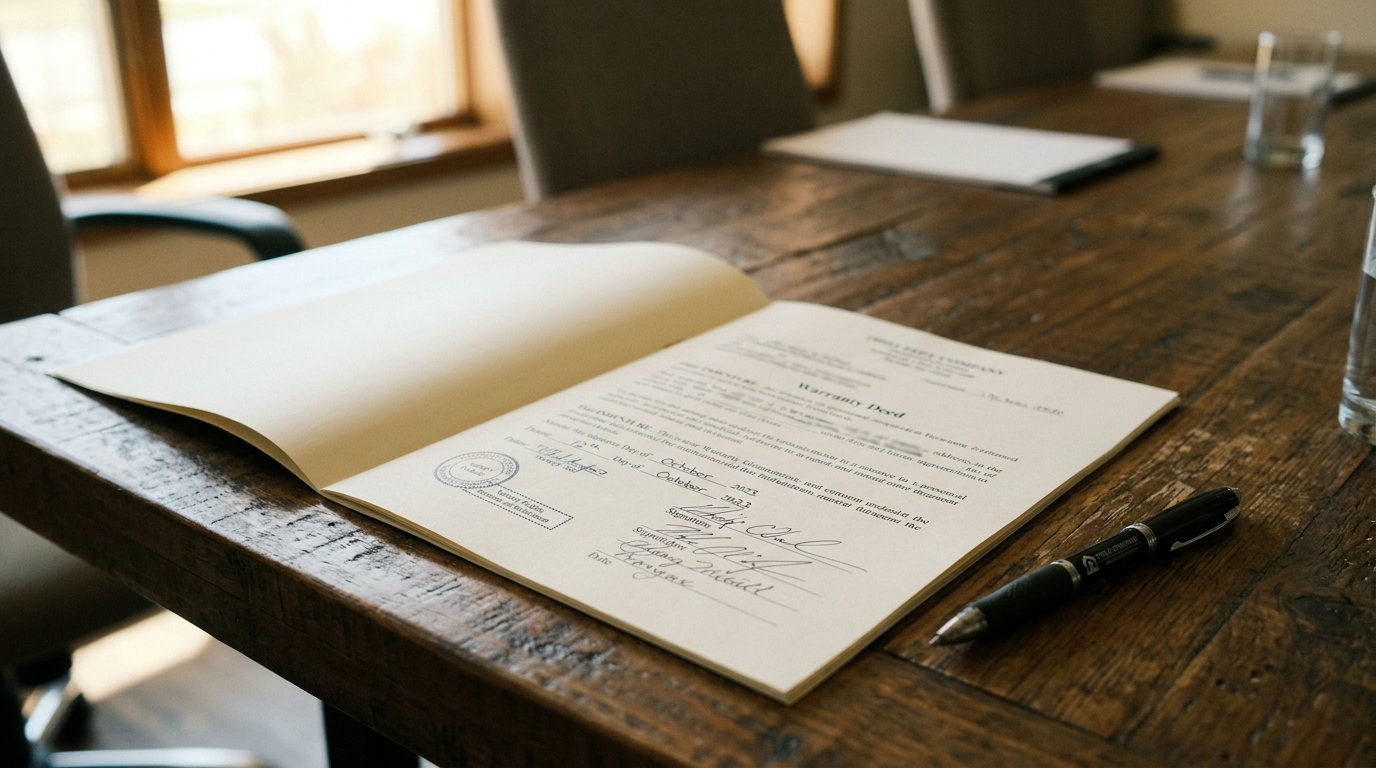
In a community property state, both spouses own the property equally by operation of law, so both signatures are required at closing regardless of what the deed says. In equitable distribution states, the titleholder can sign alone in theory, but in practice, title companies require either both signatures or a court order before they will insure the transaction.
There is a second layer many people miss: Automatic Temporary Restraining Orders. When a divorce petition is filed in California, Family Code Section 2040 immediately prohibits either spouse from selling, transferring, or encumbering marital property without the other's written consent or a court order. Many other states have similar automatic restraints that take effect at filing. Filing for divorce is not the same as being free to sell.
If you are in New Mexico, one of the nine community property states, both signatures are non-negotiable. A title company will not insure the sale and a cash buyer cannot close without them, no matter how motivated either party is to move on.

When One Spouse Refuses to Sell: The Partition Action
If one spouse wants to sell and the other will not agree, the legal remedy is a partition action. This is a lawsuit asking a court to either physically divide the property, which is impossible for a house, or order a forced sale and divide the proceeds. Courts almost always order the sale.
Partition actions work, but they are expensive and slow. A realistic timeline in most states:
- Filing and serving the petition: 1 to 2 months
- Discovery and hearings: 3 to 6 months
- Court order issued and sale completed: 2 to 6 months after the hearing
- Total from filing to proceeds in hand: typically 9 to 18 months
Attorney fees for a contested partition action commonly run between $15,000 and $40,000 total. The court may order the other party to pay, or deduct costs from sale proceeds before dividing them.
The math on a real house: a property worth $320,000 in Texas, a community property state, with an $85,000 mortgage. Net equity before costs: $235,000. After a 12-month partition action costing $25,000 in fees and $19,200 in carrying costs (at $1,600 a month for taxes, insurance, and utilities), the net drops to about $190,800, or $95,400 each. Compare that to a clean retail listing settled by mutual agreement: commissions and closing costs eat roughly $21,000, leaving $214,000, or $107,000 each. The partition action costs each spouse about $11,600 and a year they cannot move on with their lives.
Partition is the right move when the other spouse is genuinely unreachable or acting in bad faith. It is the legal remedy of last resort, not a fast solution.
Where a Cash Sale Fits Into a Divorce
A cash sale to a direct buyer cuts the timeline from months to days. There is no lender underwriting file to satisfy, no appraisal contingency to fight over, and no repair requests that require both spouses to agree on a contractor. We buy as-is, which removes one more negotiation from a situation that already has too many of them.
When both spouses can agree to sell but want it finished as fast as possible, a cash close can happen in 7 to 14 days. The title company distributes proceeds directly from the closing table, so neither spouse has to trust the other to send the right amount afterward.
A cash offer is typically below the retail market price, and you should know that going in. On a $320,000 house in decent condition, a cash offer might come in around $265,000 to $270,000. After paying off the $85,000 mortgage and splitting the remaining $180,000 to $185,000, each spouse walks away with roughly $90,000 to $92,500. That closes in two weeks instead of four months, and neither person has to coordinate showings, negotiate repair credits, or fight over which agent to use.
If the house needs significant repairs and neither spouse wants to fund them mid-divorce, the gap between a cash offer and a retail listing narrows considerably. A buyer requiring a 30-day inspection period and $18,000 in roof work is not faster or simpler than a cash close, even if the headline number looks higher.
For more on how a cash sale works in a divorce situation, see the divorce situation page.
The Capital Gains Question Before You Close
Under IRC Section 121, you can exclude up to $250,000 in capital gains from the sale of a primary residence if you owned and lived in it for at least two of the five years before the sale. Married couples filing jointly can exclude up to $500,000.
Timing the sale relative to when the divorce is finalized matters. Selling while still legally married preserves the $500,000 joint exclusion, which can eliminate capital gains tax entirely on a house with significant appreciation. After the divorce is final, each person can only claim their own $250,000 exclusion.
One more point: if one spouse stays in the house after separation, they may be able to count that occupancy toward the two-year residency requirement, even if the other spouse has already moved out. IRS Publication 523 explains the full rules. A CPA familiar with divorce situations is worth the hour before you close, not after.
Who Should Not Take a Cash Sale During Divorce
A cash offer is the wrong choice in several situations:
- The house is in excellent condition, neither spouse is in a hurry, and you can both hold it together for the 60 to 90 days a retail listing takes. A traditional sale will almost certainly net more per person.
- The mortgage payoff exceeds the cash offer, meaning you would need to bring money to closing. A short sale with lender approval or a traditional listing is the right path there.
- One spouse is pushing a quick sale specifically to reduce the other's equity claim. Courts can and do set aside sales made to deprive a spouse of marital assets. If that dynamic is present, both parties need attorneys before anyone signs anything.
A traditional listing with a cooperative real estate agent usually nets more than a cash offer when the house is in good shape and both parties can manage the marketing period without the process becoming another battlefield. We say this on our homepage and we say it here: if your situation does not require speed or certainty, a cash sale may not be the right trade.
If you are unsure which scenario fits, call us at 801-421-4212. We will tell you honestly if a cash sale makes sense for your situation. When it does, you can request a cash offer and have numbers in hand within 24 hours.
Common Questions
Can one spouse sell the house without the other's signature during a divorce?
In community property states, no. Both spouses own the property equally by law and both must sign the deed at closing. In equitable distribution states, the titleholder can technically sign alone, but title companies almost always require both signatures or a court order before insuring the transaction. Many states also impose automatic restraining orders when a divorce petition is filed, preventing either spouse from selling without consent or court approval.
What happens if we cannot agree on whether to sell or what price to accept?
If both spouses own the property and one refuses to sell, the legal remedy is a partition action, a lawsuit asking the court to order a forced sale and divide the proceeds. It works, but it typically takes 9 to 18 months and costs $15,000 to $40,000 in attorney fees that come out of the proceeds. A partition action is the option of last resort, not a practical fast track.
Is the capital gains exclusion still available when selling during a divorce?
Yes, if both spouses meet the two-year ownership and residency requirement within the five years before the sale. Selling while still legally married preserves the $500,000 joint exclusion. Once the divorce is final, each person can only claim $250,000 individually. The timing of the sale relative to the divorce decree can make a meaningful difference in the tax outcome. Review IRS Publication 523 or consult a CPA before deciding when to close.
How fast can a cash sale close during a divorce?
A direct cash purchase with both spouses in agreement can close in 7 to 14 days. There is no lender approval process, no appraisal, and no repair contingencies to negotiate. Proceeds are distributed by the title company at closing per the settlement agreement or court order, so each party receives their share the same day the deed transfers. That speed is the primary reason divorcing couples consider a cash sale even when the offer is below the retail market price.