
You can sell a fire-damaged house. The real question is which route leaves more money in your pocket after accounting for the insurance payout, repair costs, and how long each path takes. Most sellers face two variables at the same time: the open insurance claim and the property itself. Getting the order of decisions right changes the outcome by tens of thousands of dollars.
The Two Decisions Every Fire-Damaged Seller Faces
After a fire, you are making two separate decisions, and confusing them costs money.
The first is what to do with the insurance claim. Your homeowner's policy likely covers the cost to repair or rebuild the structure to its pre-loss condition. That claim belongs to you as the policyholder, not to the house. Filing it and acting on it are independent of your decision to sell.
The second is what to do with the property. You can repair it and list it, sell it as-is to a direct buyer, or combine both by collecting the payout and selling the unrepaired house for cash. Many sellers treat these as one decision because a contractor or agent frames it that way. They are not. Your right to insurance proceeds does not disappear when you decide to sell. What changes is how those funds move at closing, and that depends on whether a lender has a legal claim on them.
Who Controls the Insurance Check When a Mortgage Is Involved
This is the mechanism most guides skip, and it creates more confusion for sellers than any other part of the process.
Standard home insurance policies name your mortgage lender as a loss payee, also called a mortgagee. When the insurer issues a check for structural damage, it is made payable to both you and the lender. Your lender's loss-draft department holds those funds and releases them in stages as repairs are verified by inspection.
If you want to sell as-is without doing repairs, your lender may be sitting on the insurance proceeds. Two paths exist at that point.
The first path: negotiate with the lender to release the held funds to you at closing. Many lenders will agree to this when the mortgage is retiring in full from the sale proceeds. The reasoning is straightforward. If the debt is being paid off at closing, the lender no longer needs the collateral protected.
The second path: close the sale, pay off the mortgage from the sale proceeds, then continue pursuing the insurance claim separately after the transaction. This works in some circumstances but requires written agreements with both the carrier and the lender before you sign a purchase contract. Talk to an attorney before going this route.
If you own the property free and clear, the insurance proceeds come to you directly. There is no lender with a legal claim on those funds. You can keep the payout and sell as-is, and the two transactions are independent of each other.

What You Must Disclose When Selling a Fire-Damaged House
Every state requires sellers to disclose known fire damage. What varies is the form, the level of detail required, and what the law treats as a seller's obligation to investigate.
California uses the Transfer Disclosure Statement under Civil Code Section 1102. It asks directly about prior fire damage and related repairs. Sellers in designated High Fire Hazard Severity Zones must also provide a Natural Hazard Disclosure. Under AB 38 (effective 2020), sellers in those zones may need to document whether the home meets current fire-hardening standards or acknowledge that it has not been inspected. Prior fire damage, even if repaired years earlier, requires disclosure.
Texas uses the Seller's Disclosure Notice under Property Code Section 5.008(b). The form asks specifically whether the property experienced fire damage, whether repairs were made, and who performed the work. Skipping this creates the same liability as skipping disclosure of foundation problems.
Florida follows the common law standard from Johnson v. Davis (1985): sellers must disclose material facts that would affect a buyer's decision and are not readily observable. Fire damage is a material fact in Florida regardless of whether repairs were completed.
Kansas does not mandate a standardized disclosure form by statute. The state follows a caveat emptor framework in residential transactions. However, active concealment of known damage creates fraud liability, and the Kansas Association of Realtors disclosure form asks specifically about fire and smoke damage. Most Kansas sellers use the form, and most buyers expect it. If you own a fire-damaged property in Kansas, our page on selling a house for cash in Kansas covers what direct buyers look for in that market.
The rule that applies in every state: if you know the fire happened, you disclose it. That applies to damage repaired a decade ago. Post-sale lawsuits based on nondisclosure of fire history appear regularly in every state's case law. The seller typically loses, and the damages often exceed what was saved by not disclosing.
Keep every document from the remediation: contractor invoices, permits pulled, the air-quality clearance after smoke remediation, and the final inspection report. A buyer financing the purchase will almost certainly need them, and they protect you from nondisclosure claims after closing.
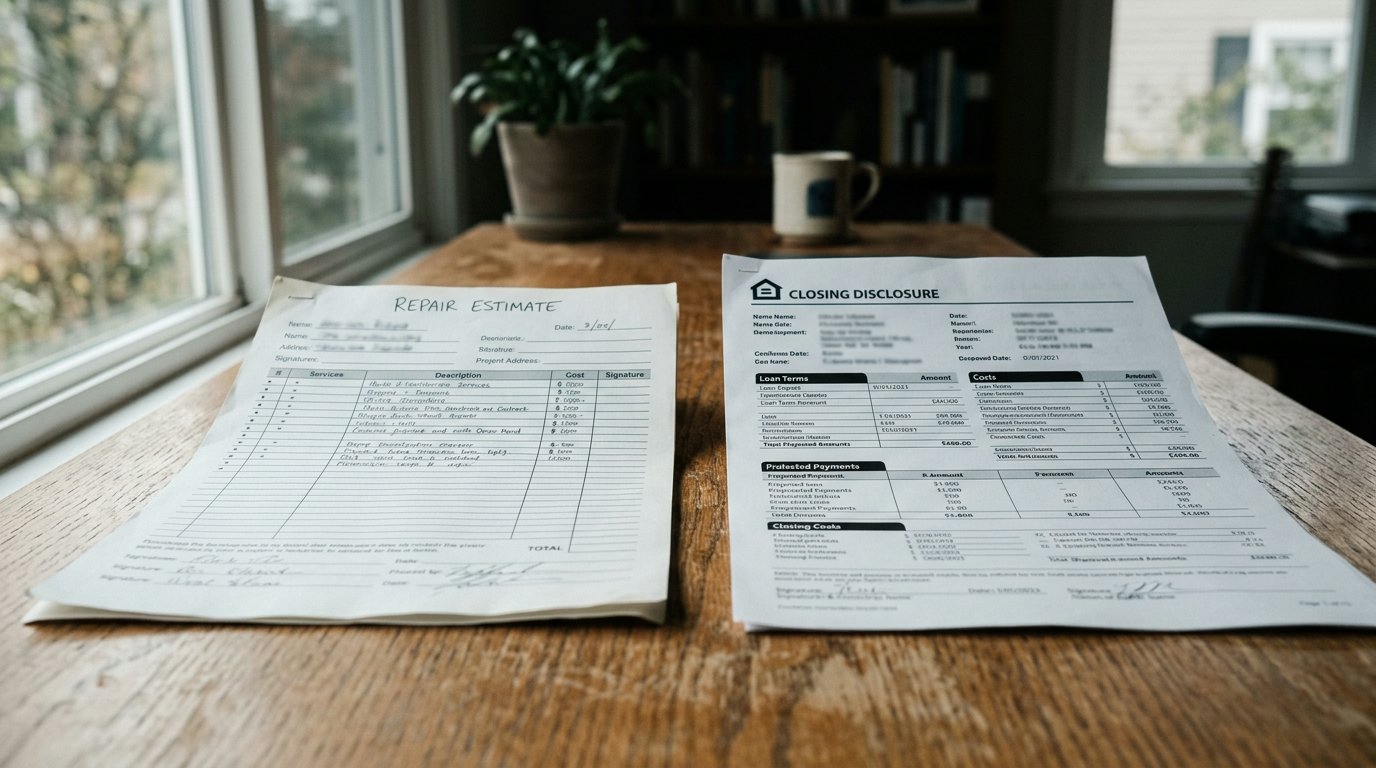
The Numbers: Repair-and-List Versus Insurance-Payout-Plus-Cash-Sale
A worked example using numbers that reflect a mid-market property.
A house with an after-repair value of $290,000 sustains a kitchen fire. A licensed contractor assesses the damage at $88,000 to restore the structure, rebuild the kitchen, and address smoke and water damage in adjacent rooms. The homeowner's policy pays $78,000 after a $10,000 deductible.
Option A: use the payout, fund the gap out of pocket, complete repairs, then list.
- Insurance payout covers: $78,000 of the $88,000 repair cost
- Seller funds the remaining: $10,000
- Agent commission at 5.5% of $290,000: $15,950
- Seller-side closing costs: $2,500
- Net sale proceeds after all costs: approximately $261,550
- Timeline from fire to closed sale: 4 to 6 months
Option B: skip repairs, sell as-is, keep the insurance payout.
- Cash offer (as-is, damage reflected in price): $175,000
- Insurance payout retained: $78,000
- Total received: $253,000
- No commission, no closing costs to seller, no contractor to manage
- Timeline from offer accepted to closed: 7 to 21 days
The difference in this example is about $8,550 in favor of Option A. That $8,550 buys four to six months of managing a contractor on a vacant property, carrying costs on a house you cannot occupy, and the market risk of renovations running over schedule, which they typically do on fire remediation jobs once walls open and hidden damage appears. In a flat or declining market, the holding cost alone can eliminate the Option A advantage entirely.
The math shifts significantly with the severity of damage. A $40,000 repair cost with a $35,000 payout on a $320,000 house makes Option A look much better. An $150,000 remediation on a $200,000 house with a $130,000 payout may make Option A look worse than it appears on paper once you price the complexity. Run the actual numbers for your property before deciding.
When Selling As-Is Is Not the Right Answer
A cash offer on a fire-damaged house will be lower than the fully repaired retail value in almost every case. That is not a fault of direct buyers. It reflects the cost of repairs, the time required to complete them, and the risk of unknowns inside the walls that do not show up in a surface assessment. Any buyer who tells you their offer will match a renovated retail sale is not being accurate about the math.
Selling as-is without repairs tends to make sense when:
- The damage is structural or involves electrical, plumbing, or mechanical systems, where costs run unpredictably once walls open
- The property is vacant during repairs, which raises insurance premiums and creates security exposure
- The seller lives out of state or cannot manage a multi-month renovation remotely
- An estate, divorce, or financial deadline requires a definite closing date with a known number
- The mortgage balance, repair gap, and holding period together make the net difference between options smaller than the effort of executing Option A
It is not the right answer for modest, contained damage. A grease fire that burned one run of cabinet and the ceiling above the stove may cost $9,000 to repair professionally. On a $340,000 house, that does not justify accepting a discounted as-is offer. File the claim, do the repair, and list the house. The numbers do not support the shortcut in that situation.
It is also the wrong answer when insurance is covering full replacement cost, the house is otherwise in excellent condition, and you have the time and capacity to manage the process. In that case, repair and list. The traditional sale will net more, and the only trade-off is the timeline.
Consider talking to a licensed public adjuster before finalizing either path, particularly on large structural claims. A public adjuster works for you rather than the carrier and often recovers a larger settlement on complex losses. The fee is typically 10 to 15 percent of any additional amount recovered, and on a $100,000 claim that fee can pay for itself quickly. Consult a local attorney as well if the insurance proceeds and the mortgage payoff interact in ways that are not straightforward.
For a full picture of what happens in a direct cash transaction for a fire-damaged property, our fire damage situation page covers the process from initial offer through closing across all 50 states. If you want to see an actual number on your property, you can reach us at trustedhomebuyersusa.com/get-a-cash-offer or by phone at 801-421-4212. There are no fees and no obligation to accept.
Common Questions
Can you sell a fire-damaged house while the insurance claim is still open?
Yes, in most cases. Selling with an open claim requires coordination with your insurer and, if a mortgage exists, your lender's loss-draft department. If the mortgage pays off in full at closing, many lenders will release held insurance proceeds at that time rather than after repairs are verified. If the claim is large or complicated, an attorney familiar with property insurance in your state can help you structure the closing so you do not forfeit proceeds you are owed.
Do you have to disclose fire damage that was fully repaired?
Yes, in every state. Even when repairs are complete and the house looks identical to its pre-fire condition, you are legally required to disclose that a fire occurred and what was done. California's Transfer Disclosure Statement under Civil Code 1102, Texas's Seller Disclosure Notice under Property Code 5.008, and Florida's Johnson v. Davis common law standard all require disclosure of prior fire damage. Non-disclosure creates post-sale liability that can survive closing for years.
Does a house lose value permanently after a fire, even after full repairs?
Not necessarily. A house with complete permitted repairs, professional smoke remediation, and documentation, including permits and air-quality clearances, can sell close to its pre-fire market value. The discount tends to come when buyers discover the fire history on their own through permit records or neighbor disclosure without prior seller disclosure. Documented, properly remediated, and disclosed fire damage carries a smaller market penalty than damage that surfaces during inspection as a surprise.
What happens to the insurance payout if you sell the house as-is?
If you own the property free and clear, the insurance payout is yours to keep regardless of how you sell the house. If a mortgage exists, the lender holds the structural damage proceeds as a loss payee. When you sell as-is and the mortgage retires at closing, most lenders will release those held funds at the same time. If the claim is still being processed at the time of closing, the disposition of future proceeds needs a written agreement with both your lender and your insurer before you sign a purchase contract.