
A vacant house costs money every month it sits empty. More importantly, most standard homeowner policies quietly restrict what they will pay out once the house has been unoccupied for 60 consecutive days, a fact most owners discover when they file a claim and it is denied. This post explains how that insurance mechanism works, what the monthly carrying costs add up to over a six or eight-month vacancy, and the math that determines whether a cash sale or a traditional listing nets you more.
What happens to your homeowner policy when the house sits empty
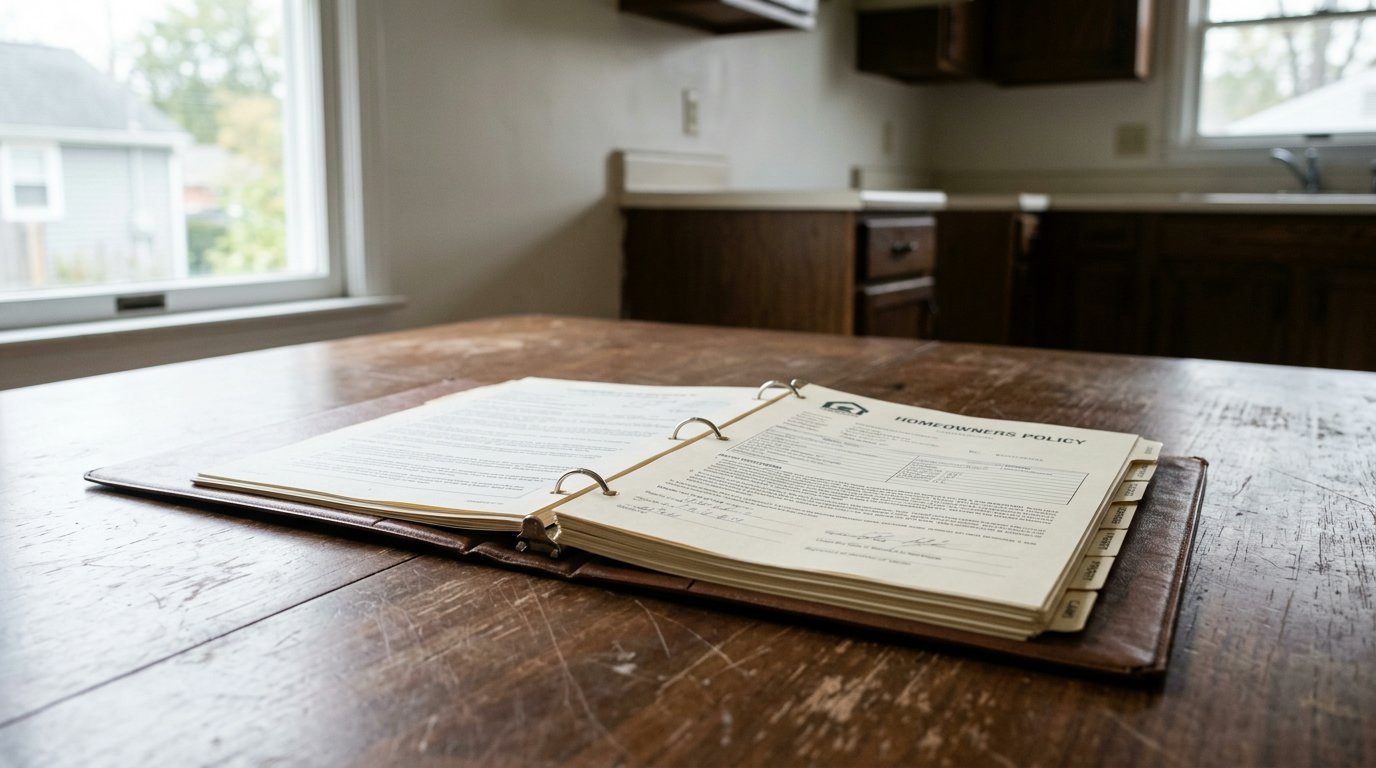
Most standard homeowner policies in the United States are written on the ISO HO-3 form. That form contains a vacancy clause: if the house is vacant or unoccupied for a continuous period beyond the threshold stated in the policy declarations, typically 60 days, the policy excludes coverage for vandalism, malicious mischief, broken glass, and certain categories of water damage.
Vacant and unoccupied are not the same thing in insurance language. A furnished house where the owner is traveling for three months is unoccupied. A house with no furniture and no personal property inside is vacant. The vacant classification triggers the stricter set of exclusions.
After 60 days without occupants, if someone breaks in and damages the property, your policy will likely deny the vandalism claim. If a pipe bursts and nobody notices for a week because no one is checking, the insurer may reduce or deny the water damage payout on the grounds that the loss grew worse because the house was vacant and uninspected.
The fix is a vacancy endorsement, also called a vacancy permit. This rider extends coverage while the house is empty, but it costs more, typically an additional $50 to $100 per month on top of your standard premium. Some insurers require proof of regular inspections, usually weekly or biweekly, as a condition of the endorsement. Call your insurer before the 60-day mark, not after a denied claim.
What the carrying costs actually add up to
The insurance rider is only one line on the monthly ledger. A vacant house typically runs these costs regardless of whether you are listing it traditionally or not:
| Cost | Typical monthly range |
|---|---|
| Property taxes (prorated) | $150 to $500, depending on state and assessed value |
| Vacancy insurance endorsement | $50 to $100 |
| Utilities (minimum heat or power to prevent freeze damage) | $50 to $80 |
| Lawn and exterior maintenance | $60 to $120 |
| Security monitoring | $30 to $60 |
| Total | $340 to $860 per month |
Property tax rates vary more than any other line item. Wyoming has one of the lowest effective rates in the country, around 0.57% of assessed value. A $250,000 house there runs about $119 per month in prorated taxes. Vermont, with an effective rate near 1.82%, puts the same valued house at roughly $380 per month. That difference alone is $261 per month, or $3,132 per year, on carrying costs that produce no return.
A house that sits vacant for eight months accumulates between $2,720 and $6,880 in carrying costs before a single showing is scheduled.
A worked example: the eight-month vacant house
Say you inherited a house in Vermont. The after-repair value is $250,000. It has been empty since January and you are now selling in September. The house is structurally sound but needs cosmetic work and the yard has been neglected for months.
Monthly carrying costs: approximately $680 (property taxes $380, vacancy endorsement $75, utilities $65, lawn $100, monitoring $60). Eight months already spent: $5,440.
Option A: list traditionally
- Gross sale at full ARV: $250,000
- Staging and cosmetic work: $4,000
- Agent commission at 5.5%: $13,750
- Carrying costs through a 90-day listing period: $2,040
- Net before Vermont property transfer tax: approximately $230,210
Option B: cash sale to a direct buyer
- Offer at 79% of ARV: $197,500
- No commission, no repairs, close in 7 days
- No additional carrying costs
- Net: $197,500
The headline gap is $32,710. But Option A requires $6,040 more in costs from today, and you have already spent $5,440 in carrying costs that are gone regardless of which path you choose. If the cosmetic work estimate comes in at $15,000 rather than $4,000, which is common in a house that has been vacant for eight months with accumulated deferred maintenance, the gap closes to under $12,000.
Vermont also levies a property transfer tax under 32 V.S.A. §9602 that typically falls on the closing settlement in a traditional sale. The rate varies depending on whether the buyer will use the property as a primary residence. On a $250,000 non-owner-occupied sale, ask your closing attorney for the current schedule before accepting an offer, since the buyer-seller split is negotiable and affects your net.
For inherited property with a probate still open, see our page on selling a vacant property for what a direct cash buyer can do before the estate formally closes. If you need to sell before probate wraps, the options vary by state and the mechanism matters.
The legal risks that grow with time
A vacant house visible from the street, with uncut grass and mail piling up, invites squatters. Adverse possession laws allow someone who occupies a property openly, continuously, and without the owner's permission to eventually assert a legal claim to the title. The statutory period varies considerably by state:
| State | Adverse possession period | Statute |
|---|---|---|
| California | 5 years | CA Code of Civil Procedure §325 |
| Florida | 7 years | FL Stat §95.16 |
| Texas | 3 to 10 years depending on documentation | TX Civil Practice and Remedies Code §16.024, §16.026 |
| New York | 10 years | NY RPAPL §501 |
| Wyoming | 10 years | WY Stat §1-3-103 |
| Vermont | 15 years | 12 V.S.A. §501 |
The near-term practical risk is not that someone will claim ownership, since that requires years of continuous occupation. The risk is that removing an occupant becomes a formal court process. Courts in most states do not allow self-help removal; you must go through an eviction or unlawful detainer proceeding, which adds attorney fees, weeks of delay, and often property damage to the situation.
Maintaining a visible presence reduces this risk. Regular mowing, collecting mail, keeping utilities on, and conducting weekly inspections all establish that the property is not abandoned. Document inspections with dated photographs. Some vacancy insurers require this documentation as a condition of the endorsement anyway.
Who should not sell a vacant house for cash
A cash offer is not automatically the right answer. It is a trade: you give up the premium that a traditional buyer pool might pay in exchange for speed, certainty, and no more carrying costs. That trade only makes sense in specific situations.
A cash sale is the wrong move if:
- The house is in good structural and cosmetic condition. A clean vacant house that photographs well can sell at or near full ARV on the open market, and a traditional sale will net more.
- The vacancy is under 60 days. You have not yet crossed the insurance threshold and carrying costs have not stacked.
- The equity is thin and every dollar counts. Running the full net-sheet with a local agent, including a real repair estimate, is worth the time before deciding.
- You have a tenant lined up. Let the rental income offset carrying costs rather than selling into a cash discount.
A direct cash buyer is worth contacting when the vacancy has stretched beyond six months, the house needs significant work that FHA or conventional lenders will not finance, an estate or probate needs to close on a specific timeline, or managing a listing remotely from another state is not practical. A cash offer is normally below what a fully marketed retail sale produces when the house is in good condition and the seller has time. That is the honest framing. The question is whether your situation fits the side of that trade where speed and certainty are worth more than the premium.
What changes about the close when the house is vacant
A vacant house closes faster in several practical ways. There is no seller occupancy period to negotiate, no tenant notice period to honor, and no furniture to move out before the buyer takes possession. Keys exchange on the day the deed records.
For a direct cash buyer, a vacant house with clear title typically closes in 7 to 10 days. The walkthrough is straightforward because there is no furniture in the way. Deed signing can be done remotely through a title company or mobile notary in most states. There is no question of the seller needing time to vacate.
If the house still carries a mortgage, the payoff statement from the lender gets satisfied at closing from sale proceeds. Outstanding utility balances, HOA arrears, or past-due property taxes are settled from proceeds on the settlement statement. You do not need to pay them separately before closing in most states.
We buy vacant houses in all 50 states, including Vermont and every other state where the carrying cost math has started to outrun the traditional listing premium. If you want a number on your property, request a cash offer here. There is no obligation and the offer comes within 24 hours. You can also call us directly at 801-421-4212.
Common Questions
Is it harder to sell a vacant house?
Yes, for two reasons. Vacant homes are harder for buyers to visualize, which reduces the buyer pool and typically produces a lower sale price on the open market. A 2019 real estate market study found vacant homes sold for roughly $11,000 less and sat on the market about six days longer than occupied comparable homes. Second, the insurance and carrying cost clock runs in the background, adding real monthly expense to a traditional listing timeline that you do not recover.
How long can a house sit vacant before the insurance stops covering it?
Most standard homeowner policies on the ISO HO-3 form stop covering vandalism, malicious mischief, and certain water damage after 60 consecutive days of vacancy. The policy does not lapse entirely, but those specific exclusions activate. A vacancy endorsement rider restores fuller coverage but costs $50 to $100 per month extra, and some insurers require weekly inspections as a condition. Check your policy declarations page for the exact threshold your insurer uses, since a small number of carriers set the window at 30 days.
Do cash buyers purchase vacant houses as-is?
Yes. A direct cash buyer purchases vacant houses in any condition, including properties with deferred maintenance, overgrown exteriors, or damage that accumulated during the vacancy. There is no financing contingency, no appraisal requirement, and no demand to make repairs before closing. The offer reflects the condition, meaning it comes in below retail. That trade-off makes sense when the cost of repairs plus the carrying costs through a traditional listing exceeds what the retail premium would have been worth.
What happens to unpaid utility bills and property taxes at closing?
Property taxes are prorated to the closing date on the settlement statement. If taxes are current, the buyer reimburses the seller for the portion of the tax period after closing. If taxes are in arrears, the past-due amount is typically deducted from the seller's proceeds at closing rather than paid separately. Outstanding utility balances on the vacant property work the same way: they appear on the settlement statement and come out of proceeds. In most states, you do not need to resolve them separately before the closing date.