
You can sell a house with mold. No federal law prevents it. The problems are disclosure (which varies significantly by state), lender eligibility (FHA and VA appraisers treat visible mold as a required repair before closing), and what that does to your buyer pool. How much of a problem you have depends on where the mold is, how much there is, and what kind of sale you want to do.
What Disclosure Law Actually Requires
There is no single federal mold disclosure statute for residential sales. The Environmental Protection Agency sets guidance on remediation and indoor air quality, but it does not write seller disclosure law. That is left to the states, and they vary considerably.
In Texas, Property Code Section 5.008 requires sellers to complete a standard disclosure form that asks directly about the presence of mold and about past or present water damage. The statute covers all residential properties with at least one unit. Hiding a known mold problem on that form is not an ambiguous choice; it is a documented misrepresentation with civil consequences after closing.
In California, Civil Code Section 1102.6 governs the Transfer Disclosure Statement, which sellers must complete for residential sales. The TDS form asks about moisture, dampness, and water intrusion. Health and Safety Code Section 17920.3(a)(13) separately classifies the presence of mold visible to the naked eye as a substandard condition, which strengthens a buyer's legal position if a seller failed to disclose.
In Maryland, Real Property Section 10-702 requires completion of the Residential Property Disclosure and Disclaimer Statement. The state's form explicitly asks whether the seller is aware of any mold that is currently present or has previously been present in or on the property. That language is specific enough that surface mold cleaned several years ago probably still requires disclosure.
Indiana's disclosure statute at IC 32-21-5-7 requires disclosure of material defects affecting the property, including water leaks, flooding, and dampness that could affect the structure or the health of occupants.
Most other states fall under a general material defects disclosure framework. If you know about a mold problem, it is almost certainly a material fact that a buyer would want to know, which means it belongs on the disclosure form regardless of whether your state has a specific mold statute. A local real estate attorney can confirm what your state form requires.
Why Mold Eliminates FHA and VA Buyers
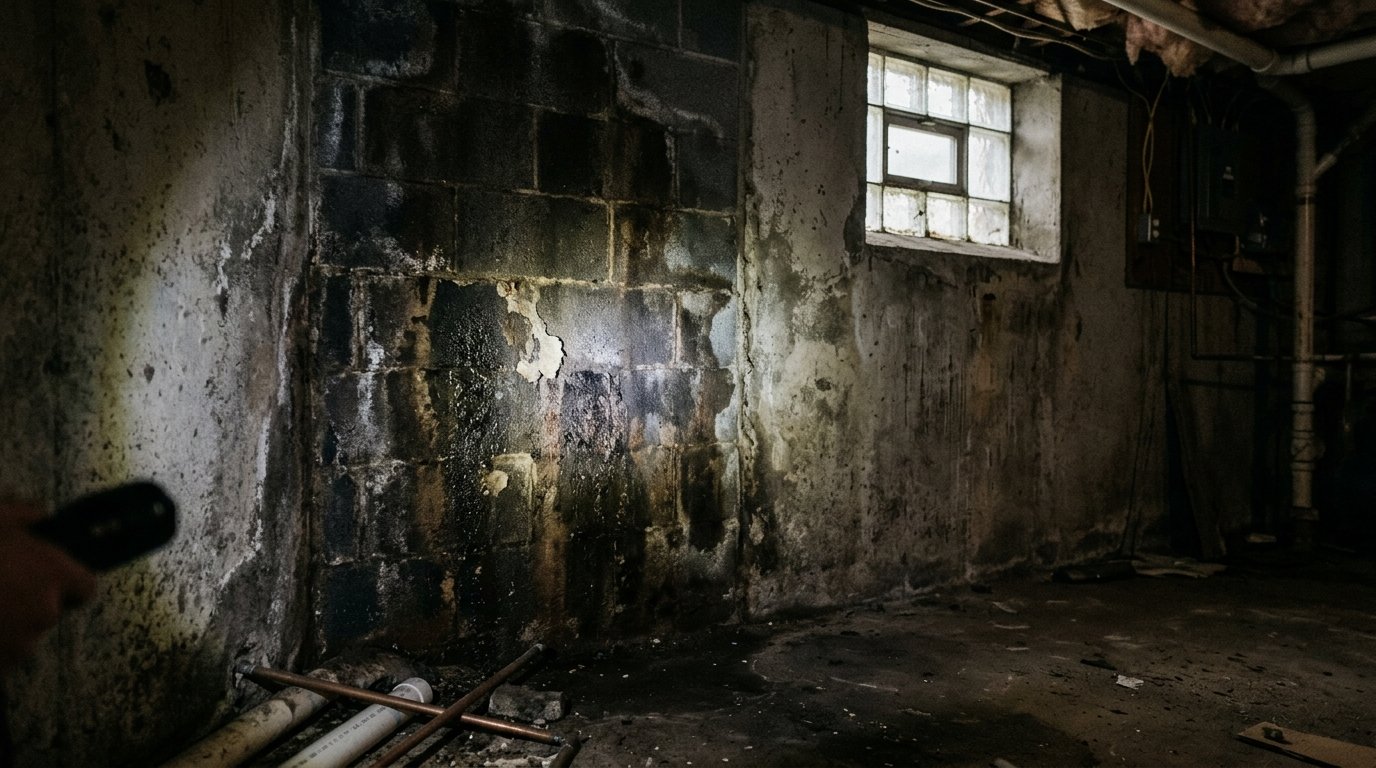
This is the mechanism most sellers do not understand until they are already under contract.
FHA appraisers work under HUD Handbook 4000.1, which establishes Minimum Property Requirements for any property securing an FHA-insured loan. Section II.A.8 classifies visible mold as a health and safety concern. When an FHA appraiser notes visible mold, the lender issues a conditional commitment requiring the mold to be remediated and reinspected before the loan funds. The work must be completed before closing, not after.
VA loans use similar language under Chapter 12 of the VA Lender's Handbook. A property with visible mold does not meet the VA's property condition requirements and must be remediated before the loan closes.
In practice, listing a house with visible mold while accepting FHA or VA buyers puts you in a position where the deal cannot close until you fix the problem anyway. You have not avoided the repair; you have deferred it to a moment when you have less leverage and a closing deadline on the purchase contract.
According to HUD data, FHA loans accounted for roughly 14 percent of all purchase mortgage originations in 2024. VA loans accounted for approximately 10 percent. A property that cannot pass FHA and VA appraisal has lost access to roughly a quarter of the financed buyer market before the first showing. In entry-level price ranges where FHA financing is common, that loss matters considerably.
| Buyer type | Can they close with visible mold? | Why |
|---|---|---|
| Conventional (Fannie/Freddie) | Sometimes, depending on appraiser notes and lender | No MPR equivalent, but lenders may still flag health and safety |
| FHA | No | HUD 4000.1 Section II.A.8 requires remediation before closing |
| VA | No | VA Lender's Handbook Ch. 12 health and safety standard |
| Cash | Yes, if disclosed | No lender appraisal required; buyer assumes condition |
The EPA Size Threshold: When DIY Is Actually Enough
EPA Publication 402-K-02-003, "A Brief Guide to Mold, Moisture and Your Home," gives the most widely cited guidance on how to approach remediation by scale:
- Under 10 square feet (about a 3-by-3-foot patch): the EPA considers this small enough for a homeowner to clean with standard protective gear. Professional cleaning at this scale typically runs $300 to $1,500.
- 10 to 100 square feet: the EPA recommends calling a professional remediation contractor. Cost: $1,500 to $5,000 depending on surface type and access.
- Over 100 square feet, or any mold involving HVAC ductwork: requires a professional firm following IICRC S520 standard procedures. Cost: $5,000 to $30,000 or more. HVAC contamination is particularly expensive because ducts distribute spores throughout the house before the source is addressed.
These are remediation scale thresholds, not disclosure thresholds. Even a patch smaller than 10 square feet requires disclosure if you know it is there.
The Fix-vs-Sell Math on a $295,000 Delaware House

Here is how the numbers work on a concrete example. A Delaware house with an ARV of $295,000 has active mold covering about 60 square feet in the crawl space, a medium-level remediation job.
Option A: Remediate and list.
- Professional remediation: $2,800
- Reinspection and clearance testing: $400
- Time off-market during remediation: 3 to 4 weeks
- Listing commission at 5 to 6 percent: $14,750 to $17,700
- Seller closing costs (transfer tax, title, attorney): approximately $5,900
- Holding costs during a 60-day listing period (mortgage, property tax, insurance): approximately $4,200
- Net proceeds: roughly $264,000 to $267,000
Option B: Cash sale as-is, mold disclosed.
- Cash offer on a $295,000 ARV property with a medium mold problem: typically 75 to 80 percent of ARV, so $221,000 to $236,000
- No commission, no seller closing costs, no holding beyond the agreed closing date
- Net: $221,000 to $236,000
In this example, Option A returns $28,000 to $46,000 more. Remediating and listing wins clearly when the mold is the main problem and the rest of the house is in retail condition. The gap narrows when the remediation estimate comes in at $15,000 or more, when there are other deferred maintenance items a buyer's inspector will flag, or when carrying costs are high because the mortgage is large.
If you own a Delaware home and want to know the actual cash number before deciding, that is a free conversation with no obligation to proceed.
Who Should Not Take a Cash Offer for a Mold Problem
A direct cash sale is not the right answer for every mold situation. These are the cases where remediating and listing is probably the better move:
- The mold is surface-level and under 10 square feet. This is a $500 to $1,500 problem, not a reason to sell at a material discount. Clean it, reinspect, disclose the prior condition, and list.
- The house is otherwise in excellent condition with no other deferred maintenance, the neighborhood is strong, and you have 60 to 90 days before you need to close.
- You have a remediation estimate under $3,000. At that number, the math in most markets favors fixing and listing over accepting a discount.
A cash sale tends to make more sense when the mold is in the HVAC system (expensive to fix and it kills FHA and VA deals regardless), when there are other structural or deferred maintenance items stacking on top of the mold problem, or when your timeline does not allow three to four weeks of remediation and reinspection.
If the house is in solid shape with an isolated, small mold patch, get a remediation quote, fix it, and list it. You will net more. If the problem is larger or the house has compounding issues, a situation involving major repairs is exactly what a direct cash buyer is built for.
What You Still Owe on a Cash Sale
A buyer waiving their inspection contingency does not release you from your disclosure obligations. Selling as-is means you are not making repairs; it does not mean you are concealing known defects. The seller disclosure form still goes to the buyer, and if you know about the mold and do not disclose it, the as-is clause does not protect you from a post-closing lawsuit.
This is true in Maryland under Real Property Section 10-702, in California under Civil Code Section 1102.6, in Texas under Property Code Section 5.008, and under the general material defects doctrine in most other states. Disclose what you know, in writing, before closing.
If you want to move without making repairs, Maryland homeowners dealing with a mold situation are welcome to call 801-421-4212 or submit the form below for a written cash offer within 24 hours. We buy as-is, in any condition, and we handle the closing on your timeline.
A traditional listing will usually net more when the house is in good condition and you have time to remediate properly before putting it on the market. But if the mold is extensive, the house has other problems, or your timeline does not allow for a full remediation cycle, a direct cash sale is often the cleaner trade. Get a cash offer to see the actual number before you decide.
Common Questions
Can you be sued if you sell a house with mold?
Yes, if you knew about the mold and did not disclose it. Most states treat mold as a material defect, and concealing a material defect from a buyer is a basis for a post-closing lawsuit. The as-is clause in a purchase agreement generally does not protect a seller who actively concealed a known problem. Disclose what you know, in writing, on the state disclosure form before closing.
Do I have to disclose mold that was previously remediated?
Maryland's disclosure form explicitly asks about mold that is currently present or has previously been present. California's framework similarly requires disclosure of conditions you know about, past or present. Even where state law is less specific, prior mold remediation is information a buyer would likely consider material. The safer position is to disclose it and document the remediation work, including the professional report and any clearance testing results.
Does mold affect a home appraisal even when the patch is small?
For conventional loans, a small surface patch may not trigger a required repair condition, depending on the appraiser's notes and the lender's guidelines. For FHA and VA loans, HUD Handbook 4000.1 and the VA Lender's Handbook both treat visible mold as a health and safety concern requiring remediation before the loan closes, regardless of size. An appraiser who notes visible mold in the report will typically flag it as a required condition.
How much does mold devalue a home?
It depends on the scale and location. A small surface patch that is remediated before listing typically has minimal effect on price if disclosed and documented. A major infestation, especially one involving the HVAC system, can reduce a home's value by 10 to 20 percent or more because it eliminates FHA and VA buyers and introduces a remediation contingency into every conventional offer. The practical impact is the remediation cost plus the discount buyers demand for the remaining uncertainty.