
You can sell a house with termite damage. Whether you repair it first, disclose it and discount the price, or sell as-is to a cash buyer depends on three things: the severity of the damage, who is financing the purchase, and your state's disclosure rules. Buyers using VA or FHA loans face mandatory inspection requirements that many sellers do not find out about until the appraisal flags the issue.
Three Tiers of Termite Damage: Not the Same Problem
The word "termite damage" covers a range that runs from cosmetic to structural. Where your house lands on that range determines which buyers can close on it and what it will cost you to get there.
Past treated activity with no structural damage. The easiest situation to handle. Most lenders need a clearance letter from a licensed pest control company confirming treatment is complete and no current activity is present. Conventional buyers typically accept a treatment certificate with little or no price reduction. The disclosure goes on the form, the letter goes in the file, and the sale proceeds.
Active infestation. A live colony means every lender will require treatment before closing. FHA and VA appraisers are trained to look for mud tubes, frass, and swarmer wings, and their reports trigger mandatory repair conditions when they find them.
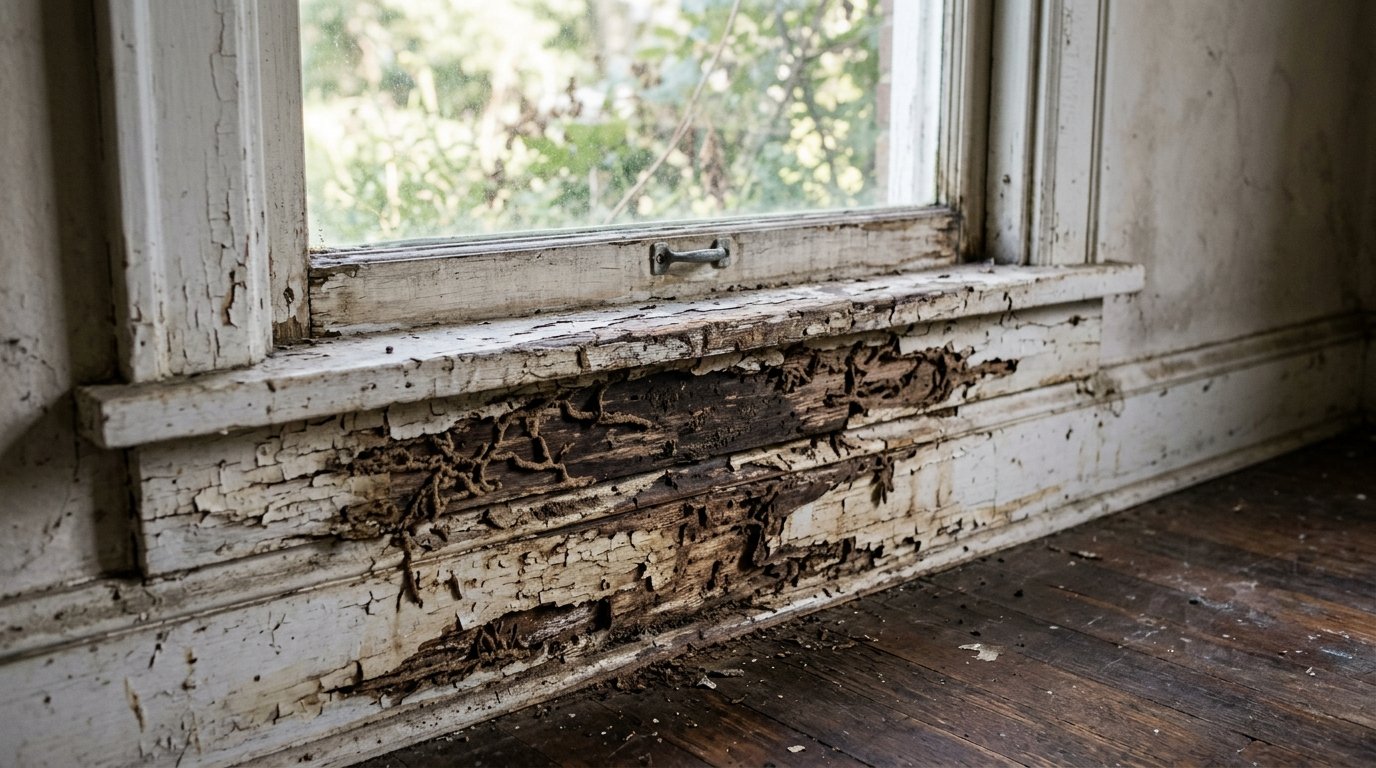
Structural damage from termites. This is the category that changes the math. Joists, sill plates, and load-bearing members weakened by decades of tunneling can cost $5,000 to $35,000 or more to repair, and that damage must be certified as repaired before most lenders will close. If you do not know the damage exists, a buyer's inspector or appraiser will find it.
The VA Mandate: WDI Inspections Required in About 25 States
The VA sets mandatory Wood Destroying Insect (WDI) inspection requirements in approximately 25 states, primarily across the South, Southeast, and portions of the Mid-Atlantic and Midwest. Under the VA Lender's Handbook (VA Pamphlet 26-7, Chapter 12, Topic 33, updated July 2025), inspections are required statewide in at least Texas, Oklahoma, Arkansas, and Louisiana. Additional states require WDI reports for most or all counties, including Florida, Georgia, North Carolina, South Carolina, Alabama, Mississippi, Tennessee, Virginia, Connecticut, and Hawaii, among others.
What this means in practice: if a buyer is using VA financing in one of those states, a licensed WDI inspector must inspect the property before closing. If the report shows active infestation or structural damage, the VA will not allow closing until treatment is complete and the affected structural members are repaired and re-certified. The seller cannot waive this. The buyer cannot waive it. It is a lender condition tied to federal guarantee requirements, not a negotiating point.

The FHA Trigger: When an Appraisal Creates a Repair Condition
FHA does not impose a blanket statewide WDI mandate the way VA does. Under HUD Handbook 4000.1, Section II.A.8.a, an FHA appraisal triggers a termite inspection when any of three conditions are present: visible evidence of active infestation, a state or local ordinance requiring inspection, or customary practice in the local market. In the Southeast, South, and much of the Southwest, appraisers treat a WDI inspection as customary practice, which means the third condition applies by default regardless of whether the seller or buyer requests it.
If the NPMA-33 inspection report shows active infestation in Section I, treatment and repair of structural damage become FHA conditions before closing. Section II findings (damage with no active infestation) are reported but do not automatically require repair, unless the appraiser determines the damage affects the property's safety or structural soundness under FHA Minimum Property Requirements. That judgment belongs to the appraiser, not the buyer or seller.
State WDO Inspection Laws: What They Require
Several states require that any Wood Destroying Organism (WDO) inspection conducted in connection with a real estate transaction be performed by a licensed inspector, regardless of how the sale is financed.
California: Business and Professions Code §8516 governs WDO inspection report types. Civil Code §1099 requires the seller or their agent to deliver a copy of any such report to the buyer before title transfers or a purchase contract is executed, if the inspection was a condition of the transaction or of the financing. Most California lenders require a WDO inspection before funding, which makes the §1099 delivery requirement operative in the majority of financed sales.
Florida: Fla. Stat. §482.226 requires that any WDO inspection for the purpose of a real estate transaction be performed by a person licensed under Chapter 482, using DACS Form 13645. For cash purchases, Florida law does not mandate a WDO inspection, but most standard purchase contracts include it as a condition, and lenders require it for all financed sales.
Texas: 4 TAC §7.175 and §7.176 require that any Wood Destroying Insect Report (WDIR) issued in connection with a Texas real estate transaction be prepared on the Texas Department of Agriculture's prescribed form by a licensed certified applicator in the Termite and Wood Destroying Insect Control category. Texas is also one of the VA's statewide-mandate states, meaning VA buyers cannot waive the WDI inspection.
Georgia: OCGA §43-45 covers pest control licensing. Any termite inspection in Georgia, including one conducted for a real estate transaction, must be performed by a company licensed under this chapter. Georgia sits in a high subterranean-termite-pressure zone, and the NPMA-33 form is standard for real estate transactions. VA and FHA buyers both trigger the inspection requirement in most Georgia markets.
Disclosure: What You Are Required to Tell the Buyer
Every state with a standard seller disclosure form asks about known termite infestation and damage. The duty is to disclose what you know. You are not required to hire an inspector before listing, but if you know an infestation exists or existed and do not disclose it, the legal exposure from a post-closing lawsuit typically exceeds the cost of disclosure and treatment combined.
The specific disclosure frameworks: CA Civil Code §1102 (transfer disclosure statement), TX PropCode §5.008 (seller's disclosure notice), FL Johnson v. Davis (1985) (known material defects), NC Residential Property Disclosure Act (direct question on the state form about insect damage). An as-is sale does not eliminate the disclosure duty. Selling as-is limits the buyer's ability to demand repairs, but it does not change what you are legally required to tell them before they sign.
Termite Damage Repair Cost Table
| Damage scenario | Typical cost range |
|---|---|
| Termite treatment only, no structural damage | $500 to $3,000 |
| Minor sill plate or joist damage | $1,500 to $5,000 |
| Moderate subfloor or floor joist damage | $5,000 to $15,000 |
| Severe structural framing (load-bearing members) | $15,000 to $35,000+ |
| Crawl space remediation with vapor barrier encapsulation | $8,000 to $25,000 |
Costs vary by region. In the Southeast, where subterranean termite pressure is highest (Reticulitermes flavipes and Coptotermes formosanus in the Gulf Coast states), structural damage often extends further before discovery because crawl spaces go uninspected for years. In drier western climates, drywood termites (Incisitermes minor in California) damage wood more slowly and tends to be more localized, keeping repair costs lower on average.
Worked Example: $285,000 Ranch in Raleigh, NC
A three-bedroom ranch in Wake County, Raleigh. Wake County is in the VA's mandatory WDI inspection zone. The house has an after-repair value of $285,000 with moderate subterranean termite damage to two floor joists and one sill plate in the crawl space: treatment $1,500, structural repairs (joist sistering and sill plate replacement) $12,000, total $13,500.
Path A, repair and list:
- Repairs (treatment plus structural): $13,500
- Realtor commission (6%): $17,100
- Closing costs (1%): $2,850
- Carrying costs (3 months at $1,750/month): $5,250
- Net to seller: $285,000 minus $38,700 = $246,300
Path B, cash sale as-is:
- No repairs, no commission, no closing costs paid by seller
- Cash offer range for $285K ARV with disclosed moderate damage: $213,750 to $228,000
- Net to seller: $213,750 to $228,000
The gap between the two paths is roughly $18,300 to $32,550 in this scenario. It narrows as repair costs rise. At $35,000 in structural repairs, Path A nets closer to $224,800, which is barely above the lower end of the cash offer range, and that assumes repairs come in on budget, the listing moves in three months, and no second inspection uncovers additional damage in the wall framing. If you are a North Carolina homeowner dealing with a major repair situation, this math is the starting framework. The actual offer depends on the specific damage scope and local market conditions.
Who Should Not Use a Cash Sale
A cash sale typically nets below a fully marketed retail price. That is the honest trade, and it is worth saying plainly. If the termite damage in your house is limited to past treated activity with no structural issues, a clearance letter from a licensed pest control company is usually sufficient to close a conventional or FHA sale. In that situation, a traditional listing will almost certainly net you more money. There is no good reason to leave that difference on the table.
The cash path makes sense when structural damage is extensive and repair costs are high relative to the ARV, when you do not have the upfront capital to fund repairs before listing, when you are in a VA-mandate state and your repair budget cannot meet the inspection clearance requirements, or when the carrying costs of a 90-day listing would add $5,000 to $8,000 or more to the total loss. Sellers who have the time, the capital, and a property with limited damage are usually better served by a traditional listing. This site says so because it is true.
Common Questions
Do you have to disclose termites when selling a house?
Yes, in every state with a standard seller disclosure form. The duty is to disclose known infestation or damage. You are not required to hire an inspector before listing, but if you know the problem exists and omit it from the disclosure form, the legal exposure from a post-closing fraud claim typically exceeds the cost of disclosure and treatment. Selling as-is does not change this rule: it limits the buyer's repair demands, not what you must tell them before they sign.
Can you sell a house with active termites?
You can sell it. You cannot close a VA or FHA financed sale with an untreated active infestation. Both loan programs require treatment and repair of structural damage as a condition of closing. Conventional lenders will also require it once an appraiser notes evidence of active infestation. Cash buyers do not have lender conditions, which is why sellers with active infestations often look to cash offers as a path to a faster close without upfront treatment costs.
How much does termite damage reduce home value?
It depends on the scope. Treated past activity with a clearance letter often has no measurable effect on price with conventional buyers. Active infestation reduces your effective buyer pool immediately to cash buyers and buyers willing to wait through treatment. Structural damage in the $15,000 to $35,000 range typically reduces value by more than the repair cost once you factor in the smaller buyer pool, the longer time on market, and the risk of additional discoveries during repairs. The clearest signal is whether a lender appraiser can condition closing on a repair completion.
Does a VA loan always require a termite inspection?
It does in approximately 25 states listed in the VA Lender's Handbook (Chapter 12, Topic 33). In those states, a licensed WDI inspector must inspect the property before the VA will close the loan. Statewide mandates apply in at least Texas, Oklahoma, Arkansas, and Louisiana. Many southeastern states and several mid-Atlantic states are also covered, either statewide or at the county level. Outside those states, the VA buyer's lender may still require an inspection at their discretion or based on appraiser findings.
If your house has termite damage and a traditional sale is not the right fit, we buy houses in all 50 states, as-is, with a written cash offer within 24 hours. Request a cash offer here.